About three weeks in, I noticed the silence.
I was sitting at my desk, working, and I suddenly realized I hadn’t thought about lunch. It was almost 2 p.m. and my brain - the brain that had, for as long as I can remember, narrated every passing hour with should I eat now, what am I eating later, how many calories have I had, did I earn dessert, shouldn’t have had that bagel, I’m so hungry, wait am I though - that brain had simply gone quiet. It was like someone had turned off a radio that had been playing, on low, my entire adult life.
If you’re on a GLP-1 and this has happened to you, you already know what I’m describing. If you’re about to start one, this may be the single most disorienting, relieving, and unexpectedly complicated side effect nobody prepared you for.
It has a name now: food noise. And what happens after it disappears is its own whole thing.
What food noise actually is (and why it isn’t a willpower problem)
Food noise is the term researchers are now using to describe intrusive, cue-driven, repetitive thoughts about eating - the mental chatter about what to eat, when, how much, whether you should have, whether you shouldn’t have. It’s not a craving. It’s a constant background hum that runs regardless of whether you’re actually hungry.
For years, this kind of rumination was filed under “low self-control” or “emotional eating.” The GLP-1 era is rewriting that diagnosis. When a medication can quiet something in weeks that two decades of therapy, dieting, and discipline couldn’t touch, it suggests the thing was never really about willpower in the first place. It was neurological.
GLP-1 receptors live in the hypothalamus (the brain’s appetite center), but they also show up in areas involved in reward, executive functioning, and (this is the interesting part) the default mode network, the brain’s “resting state” system responsible for rumination and self-referential thinking. Translation: these medications appear to act not just on hunger, but on the underlying machinery that generates repetitive thoughts about food in the first place.
Dr. Andrea Bedrosian, director of bariatrics at Northwell Health, has described it this way: for many patients, the absence of food noise is more meaningful than the weight loss itself.

The three things nobody warned you about
1. You forget to eat - and that’s a problem.
When hunger was loud, it was a timer. It told you when to stop working, when to take a break, when to refuel. Without it, entire days can go by on half a coffee and a bite of something at 4 p.m. This is how muscle loss, nutrient deficiencies, and hair shedding quietly start. Appetite suppression is the point of the medication, but undernutrition is not.
The workaround most women I know land on: schedule meals like medication. Protein-forward breakfast, protein-forward lunch, protein-forward dinner, whether your body is asking for them or not. A nutrition shake specifically formulated for GLP-1 users - designed around the math of low volume, high protein, complete micronutrients - has become a kind of category savior here, because it takes the hardest meal (usually breakfast or an early lunch) and turns it into something you can actually get down in five minutes without your stomach protesting.
2. Food stops being entertainment - which is stranger than it sounds.
A lot of women realize, a few months in, how much of their social and emotional life was organized around food. Girls’ dinners. Wine with friends. The 4 p.m. cookie at the office. The way you celebrate, commiserate, reward yourself, connect. When food loses its pull, the structure around it doesn’t disappear (you still go to the dinners) but its function changes. You start to notice how often you used food to manage your mood, fill time, or bridge awkward moments.
Some people find this liberating. Others find it genuinely disorienting, even sad. Both reactions are normal. Clinical psychologists working with GLP-1 patients note that identity around eating, body, and social rituals can shift significantly, and that these shifts are worth processing (sometimes with a therapist) rather than ignoring.
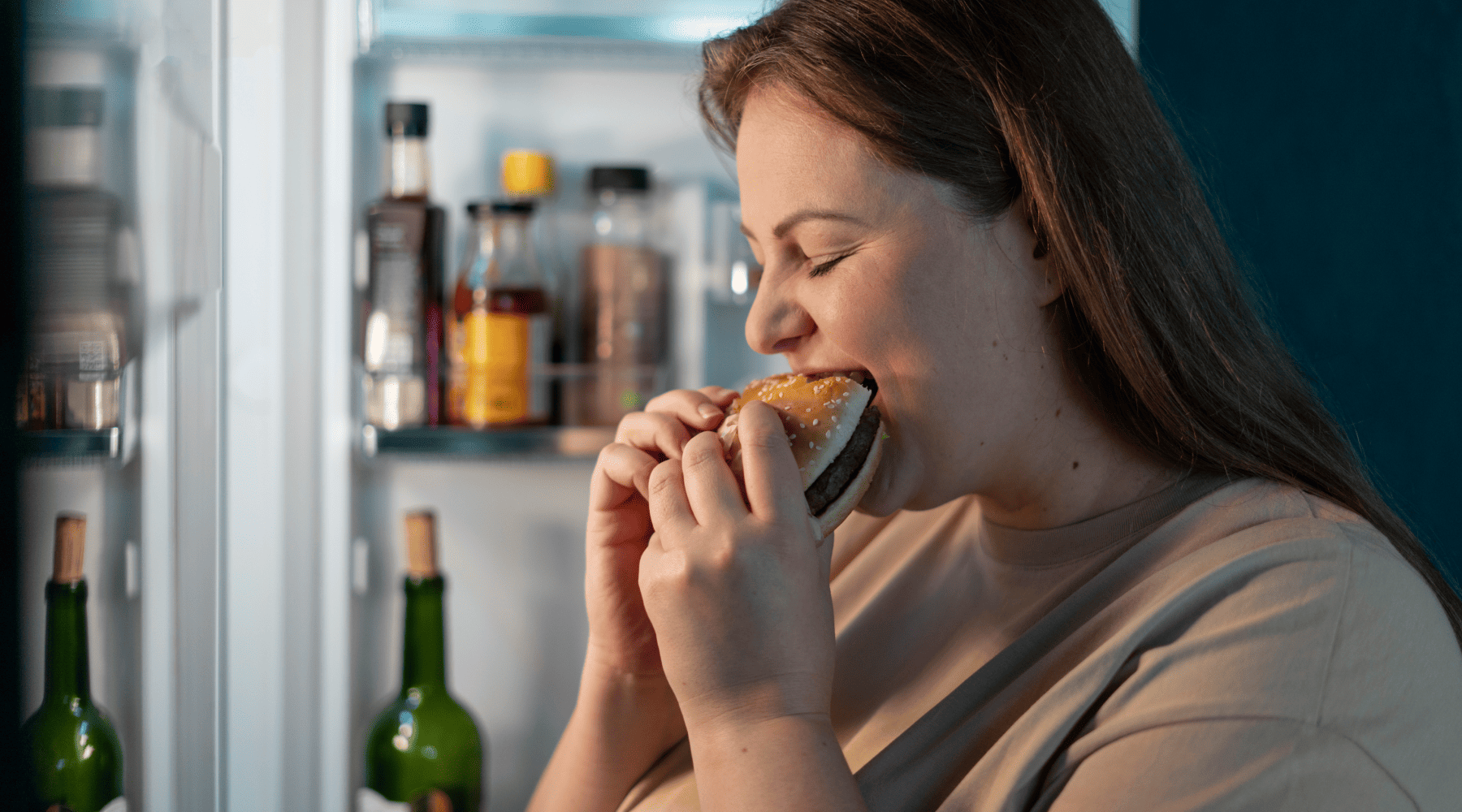
3. You have to relearn hunger cues.
This one is subtle. When GLP-1s turn down the volume, they turn down both the I could eat a house signal and the I actually need food right now signal. After months of not trusting your hunger, you lose calibration with it. When appetite starts to return - on a lower dose, on a break, after stopping - your cues won’t immediately come back clear. You may overeat because you can’t tell when you’re full. You may undereat because you never feel hungry at all.
Practicing gentle, structured eating (rather than waiting for cues) while you’re on the medication actually protects you for later, when you’re not.
The harder conversations
A few pieces of this are worth saying out loud.
For women with a history of disordered eating, the sudden disappearance of food thoughts can feel, at first, like a miracle. But an absence of food noise doesn’t automatically heal a complicated relationship with eating - it can just mask it. If you’ve historically restricted, binged, or white-knuckled your way through meals, a GLP-1 can make undereating silent and easy in ways that aren’t safe. Working with a registered dietitian or eating-disorder-informed therapist while on the medication is not an overreaction. It’s a good idea.

A second thing: the “addictive transfer” observation. Emerging research suggests GLP-1s may quiet not just food cravings but also cravings for alcohol, nicotine, and other substances - because the underlying reward circuitry overlaps. If you’re noticing you’re drinking less, that’s probably why. If you’re noticing some other craving has crept up in food’s place (shopping, phone scrolling, work), that’s worth watching too.
And the third thing, which nobody loves to hear: if and when you come off the medication, the noise often comes back. Many patients describe the return of food noise as more distressing than the eventual weight regain. Knowing this in advance - and building real eating structures, exercise habits, and stress tools while you’re on the medication - is how you protect the quiet.
What to do with the silence
For most of my life, my brain’s background program was food. Now it’s other things. Some of those things are great - I notice my kids more, I finish books, I think about what I want my life to look like in ways I genuinely didn’t have mental bandwidth for before. Some of those things are uncomfortable - old grief that food was covering for, anxiety I hadn’t realized I was snacking on, a relationship I now have to look at straight on.
That’s the trade, honestly. You get the quiet. Then you get to decide what goes in it.
This article is for informational and educational purposes only and is not medical advice. If you are struggling with disordered eating, please reach out to a qualified healthcare provider or a registered dietitian for support.
Sources
BrainWise Media, “GLP-1s May Quiet ‘Food Noise,’” December 2025 — Dhurandhar’s 29-question food noise measurement tool. https://brainwisemedia.com/glp-1s-may-quiet-food-noise/
Scientific American, “Ozempic Quiets Food Noise in the Brain — But How?” https://www.scientificamerican.com/article/ozempic-quiets-food-noise-in-the-brain-but-how/
“Quieting ‘Food Noise’: How GLP-1s and Mindfulness Rewire the Default Mode Network and Reward Circuits,” PMC, 2025. https://pmc.ncbi.nlm.nih.gov/articles/PMC12770913/
Northwell Health / The Well, “This Is Your Brain on Ozempic: How GLP-1s Quiet Food Noise.” https://thewell.northwell.edu/obesity/ozempic-glp1-food-noise
American Psychological Association, “A New Era of Weight Loss: Mental Health Effects of GLP-1 Drugs,” 2025. https://www.apa.org/monitor/2025/07-08/weight-loss-drugs-mental-health
APA (same as source 5) — role of psychologists and dietitians in GLP-1 care. https://www.apa.org/monitor/2025/07-08/weight-loss-drugs-mental-health
Harvard Media, “What is ‘food noise’ and why are we hearing about it amid the rise of GLP-1 meds?” January 2026 — Sockalingam on reward circuitry and cravings. https://www.gx94radio.com/2026/01/10/what-is-food-noise-and-why-are-we-hearing-about-it-amid-the-rise-of-glp-1-meds/
Northwell Health / The Well — Bedrosian on return of food noise after stopping. https://thewell.northwell.edu/obesity/ozempic-glp1-food-noise