Here’s the thing nobody mentions at the prescribing appointment. The moment you start a GLP-1, two numbers move in opposite directions: your appetite drops by about half, and your protein requirement goes up by about half. You are now being asked to eat significantly more of something you significantly don’t want to eat. This is the math problem at the heart of every hair-loss, muscle-loss, “why am I so tired”, “why is my weight loss stalling” story in the GLP-1 world.
Let’s do the math together. Once you see the numbers, you can’t unsee them.
Step 1: Your actual daily protein target
The old RDA everyone cites — 0.8 grams per kilogram of body weight — was set in the 1960s as a minimum to prevent deficiency. It was never designed for someone actively losing weight, and it’s now widely considered too low for anyone in a calorie deficit.
The current evidence-based target for women on GLP-1 medications, endorsed by clinicians who actually treat this population, is 1.2 to 1.6 grams of protein per kilogram of goal body weight per day.2 Stanford Medicine’s updated guidance specifically recommends the higher end — around 1.6 g/kg — for people on weight-loss medications, because the risk of muscle loss is elevated.
To convert: 1 pound = 0.45 kg. To get grams per day, multiply your goal weight in pounds by 0.55 to 0.73.
Worked examples:
A 180-pound woman targeting 140 pounds: 140 × 0.55 = 77 g minimum; 140 × 0.73 = 102 g optimal.
A 220-pound woman targeting 170 pounds: 170 × 0.55 = 94 g minimum; 170 × 0.73 = 124 g optimal.
A 160-pound woman targeting 135 pounds: 135 × 0.55 = 74 g minimum; 135 × 0.73 = 99 g optimal.
For context: the average American woman gets about 68 grams of protein a day, and that’s before a GLP-1 crushed her appetite. Most women I’ve talked to on Ozempic or Wegovy are unknowingly eating 40 to 50 grams a day. They are missing their target by half.
Step 2: The per-meal threshold nobody talks about
Here’s the nuance that separates the protein-savvy from the protein-deficient. Your body doesn’t just care about daily totals. It cares about how much you eat at one time.
Muscle protein synthesis — the process your body uses to build and maintain muscle — is triggered by a per-meal leucine threshold, typically met by roughly 25 to 30 grams of protein from mixed sources in a single sitting. Below that threshold, your body registers the meal but doesn’t fully activate the muscle-building signal. Above it, you get diminishing returns.
This means the standard American woman’s protein distribution — roughly 10 g at breakfast, 20 g at lunch, 60 g at dinner — is almost perfectly designed not to maintain muscle during weight loss. You hit the threshold once, at dinner, while spending the other 16 hours of your day in a net catabolic state.
A 2014 study on 15 adult women in the Journal of Nutrition tested this directly. When the same 90 grams of daily protein was redistributed into three balanced 30-gram meals instead of skewed toward dinner, net muscle protein synthesis over 24 hours was measurably higher. Same total. Different result.
The target: 25–30 grams of quality protein at each of three meals. Minimum.
Step 3: What 30 grams actually looks like
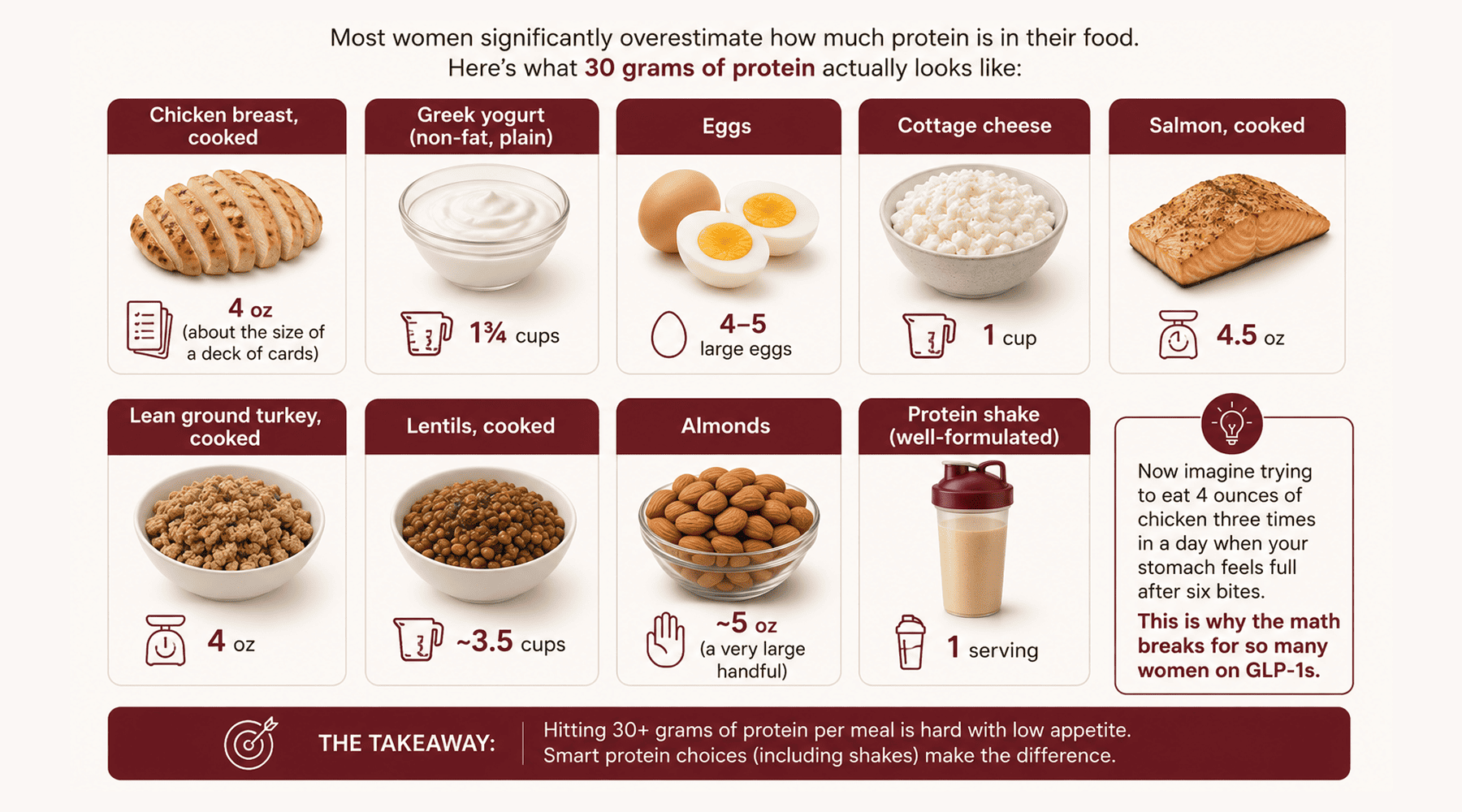
Most women significantly overestimate how much protein is in their food. This is the single most eye-opening exercise in this post. Here’s what 30 grams of protein actually looks like:
Food | Amount needed for ~30g protein |
|---|---|
Chicken breast, cooked | 4 oz (about the size of a deck of cards) |
Greek yogurt (non-fat, plain) | 1¾ cups |
Eggs | 4–5 large eggs |
Cottage cheese | 1 cup |
Salmon, cooked | 4.5 oz |
Lean ground turkey, cooked | 4 oz |
Lentils, cooked | ~3.5 cups |
Almonds | ~5 oz (a very large handful) |
Protein shake (well-formulated) | 1 serving |
Now imagine trying to eat 4 ounces of chicken three times in a day when your stomach feels full after six bites. This is why the math breaks for so many women on GLP-1s.
Step 4: The practical playbook
1. Front-load breakfast.
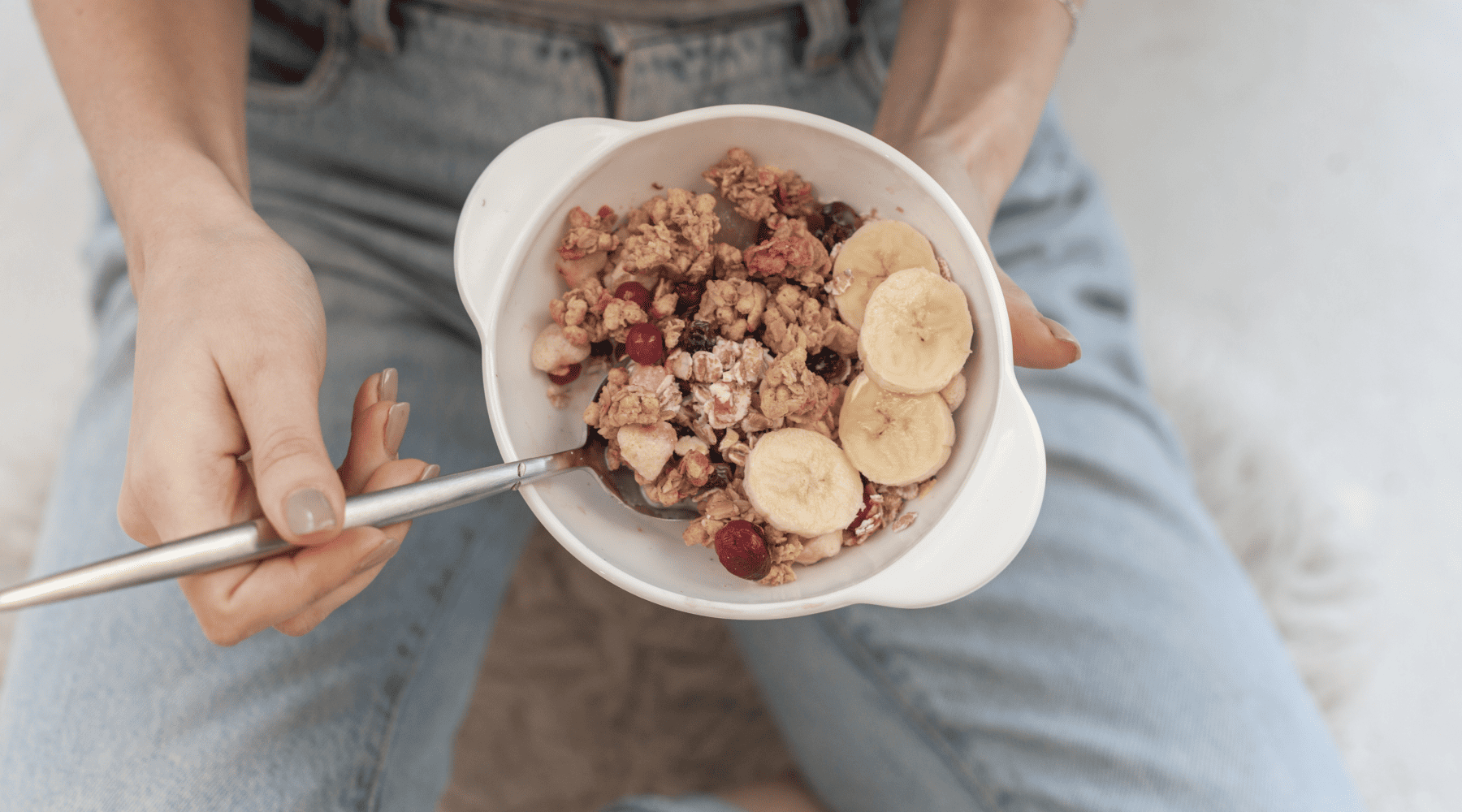
The standard American breakfast — toast, cereal, coffee, maybe a banana — gets women about 8 to 12 grams of protein. That’s the meal most easily fixed. Swap to three eggs plus Greek yogurt (or a protein shake) and you’ve gone from 10 to 30 grams with zero extra volume. Every muscle-preservation study on older women points to breakfast as the meal with the biggest upside.
2. Use protein shakes strategically, not apologetically.
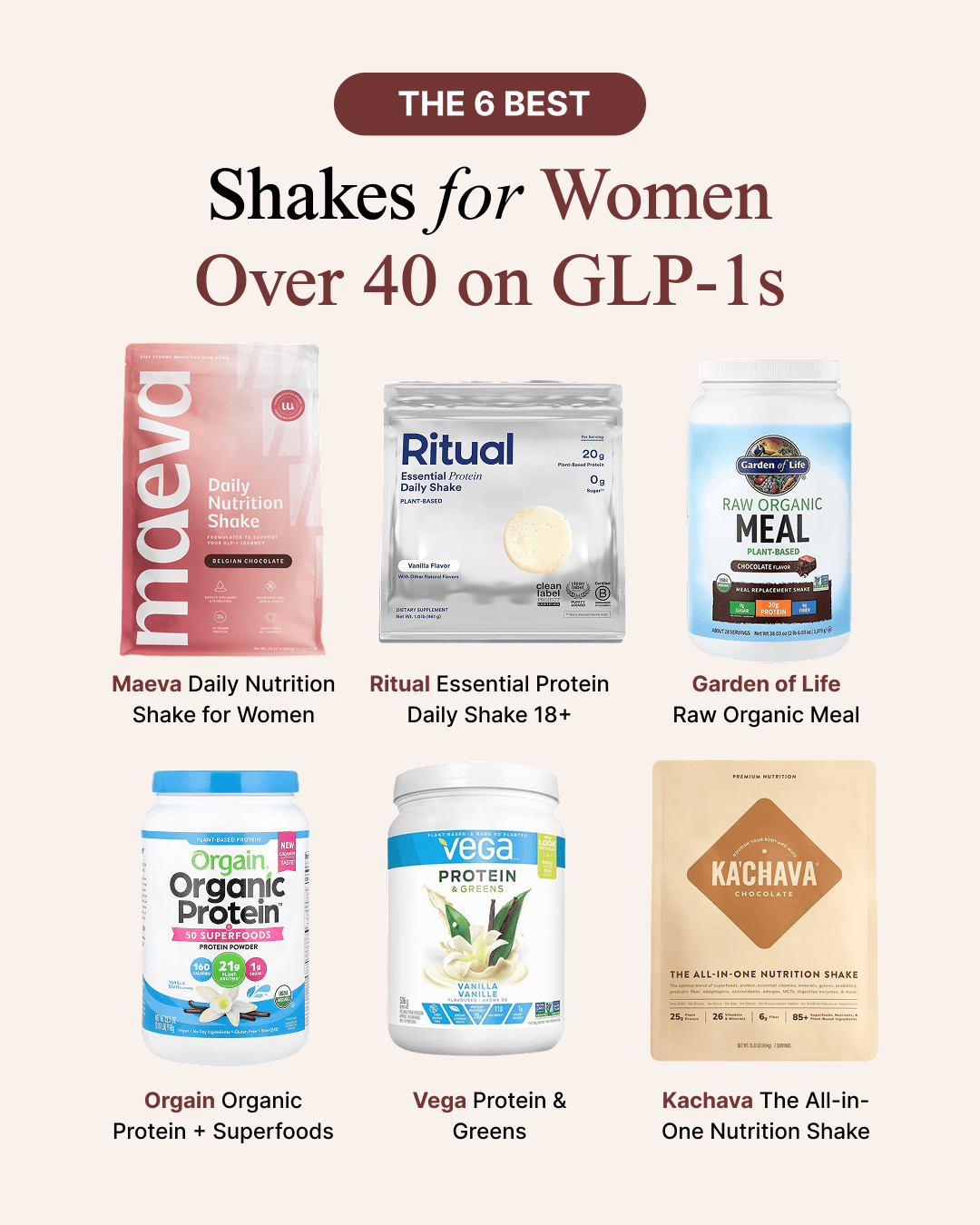
If your appetite is suppressed, a well-formulated nutrition shake specifically designed for GLP-1 users — high protein, low volume, complete amino acid profile, gentle on a slow-emptying stomach — is often the single most effective tool for hitting daily protein. One shake can do the work of three chicken breasts. The goal isn’t to replace food forever; it’s to make sure you’re never stranded at 2 p.m. with 20 grams of protein in your day.
3. Prioritize leucine-rich, complete proteins.
Not all 30-gram servings are equivalent. Whey and other animal proteins have higher leucine content (around 10%), which makes them more efficient at triggering muscle protein synthesis than most plant proteins (typically 6–8%). If you’re primarily plant-based, you’ll need slightly more grams per meal — closer to 35–40 g — to hit the same leucine threshold.
4. Track for one week. Just one.
Download a tracking app — MyFitnessPal, Cronometer, MacroFactor, anything. Log everything for seven days. Not forever; just long enough to see what your actual baseline is. I have yet to meet a woman on a GLP-1 who wasn’t genuinely shocked by the gap between what she thought she was eating and what she actually was.
The bottom line
Every single bad side effect of GLP-1s that involves your body losing something it shouldn’t — muscle, hair, skin quality, bone density, immune function — traces back to insufficient protein. This is the one nutritional variable where getting it right protects nearly everything else, and getting it wrong quietly undermines your entire reason for being on the medication.
Run the numbers for yourself. Then actually hit them. Your future self — the one with her muscle, her hair, and her metabolism intact — will be genuinely grateful.
This article is for informational and educational purposes only and is not medical or nutritional advice. Please consult your healthcare provider or a registered dietitian before making significant changes to your diet.
Sources
Stanford Medicine, “How much protein should we really be eating? Five things to know,” 2026. https://med.stanford.edu/news/insights/2026/03/how-much-protein.html
“Preservation of lean soft tissue during weight loss induced by GLP-1 and GLP-1/GIP receptor agonists: A case series,” PMC, 2024. https://pmc.ncbi.nlm.nih.gov/articles/PMC12536186/
Endocrine Society, “Consuming more protein may protect patients taking anti-obesity drug from muscle loss,” 2025 (Haines et al., Mass General). https://www.endocrine.org/news-and-advocacy/news-room/endo-annual-meeting/endo-2025-press-releases/haines-press-release
“Is leucine content in dietary protein the key to muscle preservation in older women?” PMC. https://pmc.ncbi.nlm.nih.gov/articles/PMC6248570/
“Impacts of protein quantity and distribution on body composition,” Frontiers in Nutrition, 2024. https://www.frontiersin.org/journals/nutrition/articles/10.3389/fnut.2024.1388986/full
“Impacts of protein quantity and distribution on body composition,” PMC, 2024 — balanced vs. skewed protein distribution in adult women. https://pmc.ncbi.nlm.nih.gov/articles/PMC11099237/
“Leucine supplementation chronically improves muscle protein synthesis in older adults consuming the RDA for protein,” ScienceDirect. https://www.sciencedirect.com/science/article/abs/pii/S0261561412000210
Gatorade Sports Science Institute, “The Impact of Protein Quantity, Quality, Distribution, and Food Matrix on Muscle Protein Synthesis.” https://www.gssiweb.org/research/article/the-impact-of-protein-quantity--quality-distribution--and-food-matrix-on-muscleprotein-synthesis